Digital marketing has changed dramatically over the last decade. From websites and SEO to social media, paid advertising, analytics and content creation, businesses now depend heavily on digital platforms to reach their customers.
But we are entering another major transformation: Artificial Intelligence (AI).
AI is already changing how marketers create content, analyse data, manage advertising and understand customers. This naturally raises an important question: Will digital marketing still exist 10 or 20 years from now, or will AI take over everything?
The answer is more interesting than simply “yes” or “no.”
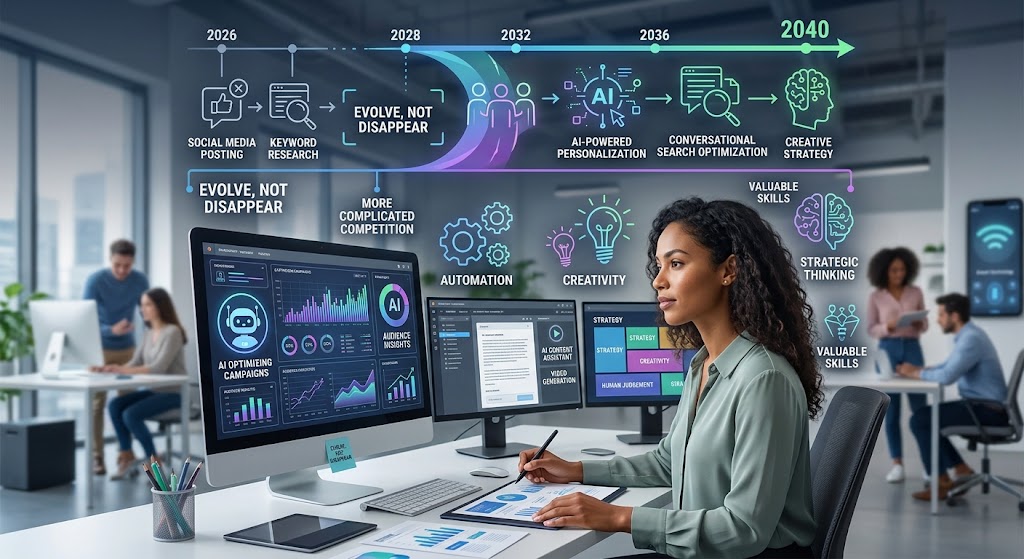
Digital Marketing Will Evolve, Not Disappear
Digital marketing is unlikely to disappear completely. Instead, the work involved in digital marketing will continue to evolve as technology develops.
In 2026, digital marketing includes:
- Search Engine Optimization (SEO)
- Social media marketing
- Google Ads and Meta Ads
- Content marketing
- Email marketing
- Website development and optimization
- Lead generation
- Analytics and reporting
- Video and visual content
- Conversion optimization
- Marketing automation
- AI-assisted marketing
Over the next 10–20 years, many of these activities may become increasingly automated.
The important change will be that marketers may spend less time performing repetitive tasks and more time focusing on strategy, creativity, decision-making and customer understanding.
What Could Digital Marketing Look Like in 2030?
By around 2030, AI may become a normal part of almost every marketing workflow.
AI systems could help marketers:
- Research target audiences
- Analyse competitors
- Identify customer trends
- Generate content ideas
- Create social media posts
- Produce advertising variations
- Personalize marketing messages
- Analyse campaign performance
- Recommend budget adjustments
- Generate reports
- Automate repetitive marketing tasks
- Assist with SEO and search visibility
Instead of manually doing every step, marketers may increasingly work alongside AI systems.
The role could shift from:
“I need to create everything myself.”
to:
“I need to tell AI what we are trying to achieve, evaluate what it produces and make the right marketing decisions.”
Will AI Replace Digital Marketers?
AI is likely to replace or automate many individual tasks, but that does not necessarily mean it will replace the entire profession.
Tasks such as basic content writing, repetitive reporting, simple data analysis, content variations and some advertising processes can increasingly be automated.
However, marketing involves much more than producing content.
A business still needs someone to understand:
- Who is the customer?
- What does the customer need?
- What makes the business different?
- What should the brand communicate?
- Which message will connect with the audience?
- What marketing objective are we trying to achieve?
- Is the campaign appropriate for the brand?
- What should we change when the results are not as expected?
These areas require strategy, context, creativity, communication and human judgement.
Will Digital Marketing Become Easier or More Complicated?
It could actually become both easier and more challenging.
Easier execution
AI can make many technical and repetitive tasks easier.
For example, a marketer could ask AI to:
- Create a content calendar
- Suggest keywords
- Generate ad variations
- Explain analytics
- Create a campaign structure
- Draft a blog
- Analyse customer data
This can save considerable time.
More challenging competition
At the same time, if everyone has access to powerful AI tools, simply knowing how to generate content will no longer be enough.
When content becomes easier to produce, quality, originality, strategy and differentiation become more important.
The question will not simply be:
“Can you create content?”
It will be:
“Can you create the right content for the right audience for the right business objective?”
Will Digital Marketing Courses Still Exist?
Yes, but digital marketing education will also evolve.
A course in 2026 may focus on:
- SEO
- Google Ads
- Meta Ads
- Social media marketing
- WordPress
- Analytics
- Content marketing
- Email marketing
- Lead generation
- AI tools
Future courses may increasingly include:
- AI marketing
- AI agents
- AI-powered search
- Conversational search
- Marketing automation
- Predictive analytics
- Customer data analysis
- Personalization
- AI-assisted advertising
- AI content strategy
- Brand strategy
- Customer psychology
- Creative strategy
So digital marketing courses are unlikely to disappear. The syllabus will simply keep changing with technology.
What Will Happen to SEO?
SEO is another area that is already evolving.
Traditionally, SEO has focused on helping websites appear in search-engine results.
As people increasingly use AI-powered and conversational search experiences, marketers may need to think beyond traditional search rankings.
The future could involve questions such as:
- How can my brand appear in AI-generated answers?
- How can my website become a trusted information source?
- How can my content remain useful in conversational search?
- How can I build authority around my brand?
SEO may therefore not disappear. It may become a broader discipline involving search visibility, content quality, authority and AI discovery.
What Skills Will Become More Valuable?
As AI handles more repetitive work, certain human skills may become increasingly important.
Strategic thinking
Understanding the business problem behind a marketing campaign.
Creativity
Developing original ideas instead of simply producing more content.
Analytical thinking
Understanding data and knowing what the numbers actually mean.
Communication
Explaining ideas clearly to clients, teams and customers.
Customer understanding
Understanding people’s needs, behaviour and expectations.
Brand building
Creating a recognizable and meaningful brand.
AI literacy
Knowing how to use AI effectively, verify its output and integrate it into marketing.
Continuous learning
Technology will continue changing, so marketers will need to keep learning.
Why Graphic Design and Digital Marketing Could Work Well Together
The combination of graphic design and digital marketing can become especially interesting in an AI-driven future.
A designer may ask:
“How should this look?”
A digital marketer may ask:
“How will this reach the right audience?”
Someone who understands both can ask:
“How can we communicate the right message visually and reach the right audience effectively?”
AI can help produce designs, captions, videos and campaigns faster, but humans still need to decide what should be created, why it should be created, who it is for and whether it communicates the intended message.
This makes the combination of design + marketing + AI a potentially powerful skill set.
From Content Creator to Marketing Strategist
Marketing roles may gradually shift from task-based work toward strategy.
Instead of simply being asked to:
“Create social media posts.”
a future marketer may be expected to:
Understand → Plan → Create → Automate → Analyse → Improve
This could lead to evolving roles such as:
- AI Marketing Specialist
- Marketing Automation Specialist
- AI Content Strategist
- Growth Marketing Specialist
- Digital Strategy Consultant
- AI Search Specialist
- Creative Strategist
- Brand and Marketing Strategist
Some of these roles already exist in early forms, while others may develop further as AI becomes more integrated into marketing.
What Should Someone Learning Digital Marketing in 2026 Focus On?
Instead of trying to memorize every marketing tool, it may be more useful to build a strong foundation in:
- Marketing fundamentals
- SEO
- Social media
- Paid advertising
- Analytics
- Content creation
- Graphic design
- Customer psychology
- AI tools
- Strategy
- Communication
Tools will change.
Platforms will change.
Algorithms will change.
But understanding people, businesses, communication and marketing principles will remain important.
The Future May Not Be Humans vs AI
The future of digital marketing may not be about humans competing against AI.
It may be about humans working with AI.
A marketer who only knows how to perform repetitive tasks may face increasing automation.
But a marketer who understands business, creativity, customers, strategy, data and AI can use these technologies as powerful tools.
That is why the more useful question may not be:
“Will AI replace digital marketers?”
It may be:
“What kind of digital marketer will be valuable in an AI-powered world?”
Final Thoughts
Digital marketing 10 or 20 years from now may look very different from digital marketing in 2026.
Some tools we use today may disappear. New platforms and technologies will emerge. AI may handle many tasks that currently require human effort.
But the fundamental purpose of marketing will remain:
Understand people. Communicate value. Build trust. Connect businesses with customers.
The technology will change, but the need to understand people and businesses will remain.
For anyone learning digital marketing today, the goal should not be to learn every tool that exists in 2026.
Instead, build strong marketing fundamentals, develop creativity and strategic thinking, learn how to work with AI, and stay curious.
The future of digital marketing may not belong to people who compete with AI. It may belong to people who know how to combine human thinking with the power of AI.